

Wooden pallets facilitate efficient package consolidation, secure packaging, and reliable fastening of goods during international transportation. Their effectiveness stems from their reusability, versatility, and affordability; crafted from readily available, low-quality wood, they maintain essential physical characteristics without incurring high costs. Daniel T Anderson, an engineering writer at essay help on time service, highlights that pallets significantly streamline and expedite loading and unloading processes for various goods, while also enhancing safety during delivery.
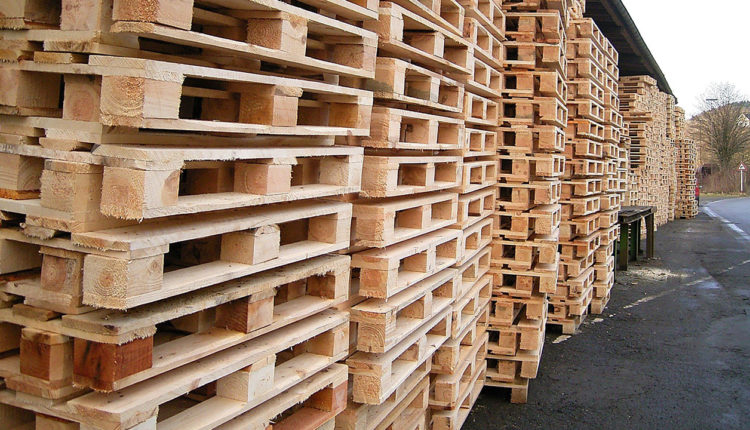
A pallet serves as a flat platform designed for rectangular and diverse cargo types. It incorporates bottom slots, accommodating forklifts, and protrusions engineered for sling-based weight movement. Predominantly used in freight transport, pallets create enlarged cargo units (CCUs), which are essentially specific quantities of goods secured together, designed to speed up the loading and unloading operations.
Types of pallets
Among the various pallet types, the europallet stands out as one of the most prevalent. Standard europallet dimensions are 1200x800x145 mm. The upper structure comprises five boards: three wide (145 mm) and two narrow (100 mm), arranged alternately. Conversely, the lower section features three boards: two narrow ones positioned on the sides and a wide one in the center. Supported by nine legs, the outermost measure 78x100x145 mm, while the central ones are 78x145x145 mm.
The dimensions of standard europallets align with the internal dimensions of containers. Notably, the EUR brand mark, enclosed in an oval, is consistently present on the right legs. While wooden pallets are the most common, the international standard UIC435-2 formally defines standard europallet sizes.

Currently, pallets are manufactured using wood, plastic, chipboard, and metal. Pallet weights vary depending on the material. Although the standard does not specify a precise weight for the 1200x800 europallet, wooden pallets typically range from 15 to 20 kg, while double-sheeting wooden pallets can weigh up to 40 kg. The carrying capacity of wooden 1200x800 europallets is contingent on wood type. Lightweight wooden pallets of the same dimensions are employed for transporting lighter goods, such as clothing. These pallets generally weigh between 8-10 kg and can support up to 2.5 tons statically or 1 ton dynamically. The maximum permissible carrying capacity for standard europallets is 2 tons.
Loads can be secured on pallets via three primary methods:
- Special packing, where the load's own weight provides stability, ideal for heavy items like sugar bags, flour, or gold bars.
- Binding with durable fixing tapes made of metal, polymer, or woven materials.
- Wrapping the cargo with specialized film, most commonly stretch film. The maximum allowable height for europallets with a load is 1.8 meters.
Standard pallets
EUR and FIN pallets represent the most frequently utilized types. Further details are provided below:
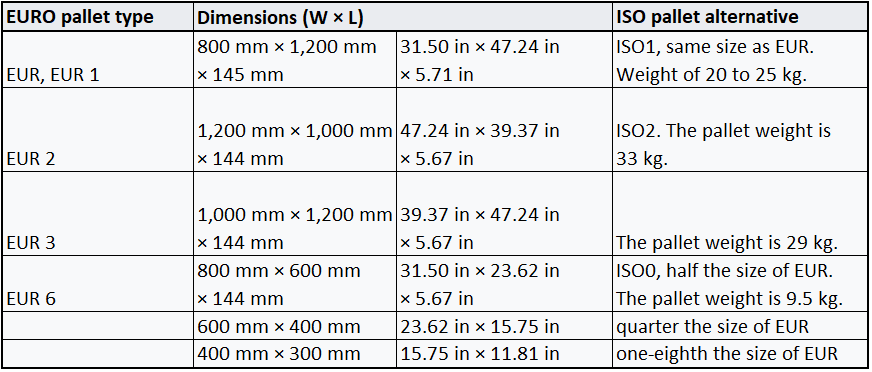
Standard pallet sizes in inches and millimeters
1000 mm equates to 39.37 inches.
Key types include:
- Euro pallet (EUR-pallet): 800x1200x145mm
- Fin pallet (FIN-pallet, Finnish pallet): 1000x1200x145mm
- Eurobox (EUR-box): A metal cage featuring a europallet base, sized at 800x1200x800mm

According to ISO 6780, the typical dimensions for wooden pallets are 1000x1200x145 mm (WxLxH). Production commonly utilizes boards with widths of 10 or 12 cm. Standard pallet weight is influenced by the mass of constituent elements (bars, planks), determined by wood type, origin, and moisture levels.
Pallets constructed from dense, heavy wood can weigh up to 24 kg. Conversely, using dried porous wood blanks can reduce the final product's weight to 10 kg or less. The load capacity of wooden pallets typically spans from 1000 to 2500 kg.
Main dimensions and tolerances are summarized in the following table.
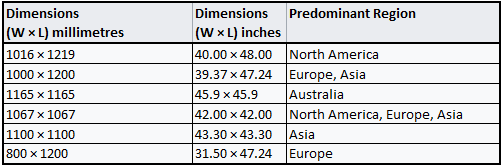
Wide and short pallets
Pallets measuring 1200x1200 mm are specifically produced for handling dimensional cargo. While not commonly used in cargo transportation, they find application in warehouses and production facilities. These wide, reinforced pallets consist of boards ranging from 18 to 25 mm in thickness, assembled using high-strength twisted nails.
Shortened (lightweight) pallets, sized at 1200x800 mm, are among the most affordable and versatile options. These flat, four-way pallets are widely adopted due to their low cost and effective performance. They typically support lifting capacities of up to 1 ton and weigh up to 40 kg.
American Pallets
In North America, the de facto standard is the 48×40 inches (1219×1016 mm) pallet, gaining prominence in the 1960s. This size is also one of the six standard ISO pallet dimensions. The GMA pallet has been an informal benchmark for high-velocity supply chains involving fast-moving consumer goods (FMCG), although considerable variations existed for decades concerning component thickness and width, knot quality, wood species, fastening materials, equipment operation, and damage resistance. Given this variability, specifying detailed requirements to suppliers or shippers remains crucial. GMA pallets are commonly available as either new or used (recycled).
The adoption of 48×40 inch pallets within consumer goods supply chains expanded in the late 1990s and early 2000s, facilitated by rental companies like CHEP pallets and later PECO, enhancing accessibility for US clients. It's worth noting that these pallets were already common in other supply chains and in Europe. Regarding CHEP pallets, the standard North American size is 48×40 inches, with a more recent introduction of a 24×40 inch semi-pallet. In Canada, a 48×20 inches CHEP pallet is typically offered. Globally, CHEP pallet sizes generally align with existing or developing standards within their respective regions.
Presently, approximately 30% of US pallets measure 48 × 40 inches. The following chart illustrates prevalent measurements based on studies conducted several years ago at Southern Illinois University, noting dimensions are listed as width by length.
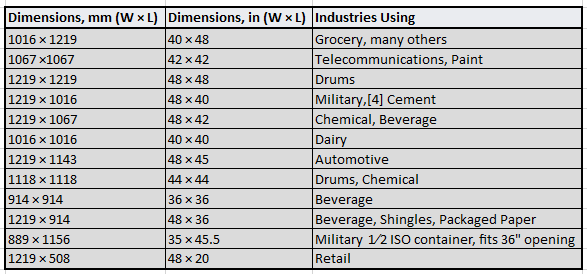
Common pallet sizes in the United States
How many pallets fit into a container
Given the standard pallet size of 1200x800x145 mm, a standard 20-foot container can accommodate 11 euro pallets in a single tier. The container's width constraints prevent equal placement in two rows, either lengthwise or crosswise. Consequently, the first row typically holds seven pallets placed crosswise, while the second accommodates four pallets lengthwise.
A 40-foot container can hold approximately 23-24 europallets. Similar to the 20-foot container, one row is positioned across the body, allowing for up to 11 units.
A standard tilt truck with a length of 13.6 m can accommodate 32 euro pallets when placed with the long side across the body (16 rows of 2 pallets – 0.8 x 16 = 12.8 m), or 33 if oriented with the short side ("triples," 11 rows of 3 pallets – 11x1.2 = 13.2 m). The latter configuration generally provides a more secure load.
Loading containers of varying sizes involves preliminary calculations based on standard pallet dimensions and vehicle parameters. It's essential that cargo does not extend beyond the pallet's edges and that wooden europallets possess sufficient durability to support the load's weight.
The following diagrams illustrate pallet arrangement within 20- and 40-foot containers, respectively. Additional placement options are available on the pallet types page.


The use of pallets in freight traffic
The earliest form of the pallet was the skid, first used in early twentieth-century American factories to consolidate packages for weapons transport. A skid comprised a wooden board with attached side boards. Over time, the skid evolved, and in 1925, the addition of another shield to the boards marked the prototype of the modern pallet.
Distinguishing between pallets and cargo space is crucial. In international traffic, shipping documents often specify the number of packages, referring to any cargo unit that can be handled without repackaging.

Today, pallets are widely used during transportation, primarily due to automation of the loading/unloading processes and enhanced cargo safety. Pallets ensure cargo is delivered intact, without issues related to reloading.
Pallet loading with a forklift
Cargo pallets can be categorized by several parameters. Based on service life, pallets can be either disposable or multi-turn. Disposable pallets are discarded after use, whereas multi-turn pallets are reusable without compromising their properties or characteristics.
Regarding forklift access, pallets are classified as two-way or four-way. Two-way pallets are accessible from two opposite sides, while four-way pallets can be accessed from all four sides. This minimizes the potential for damage to the cargo during handling.
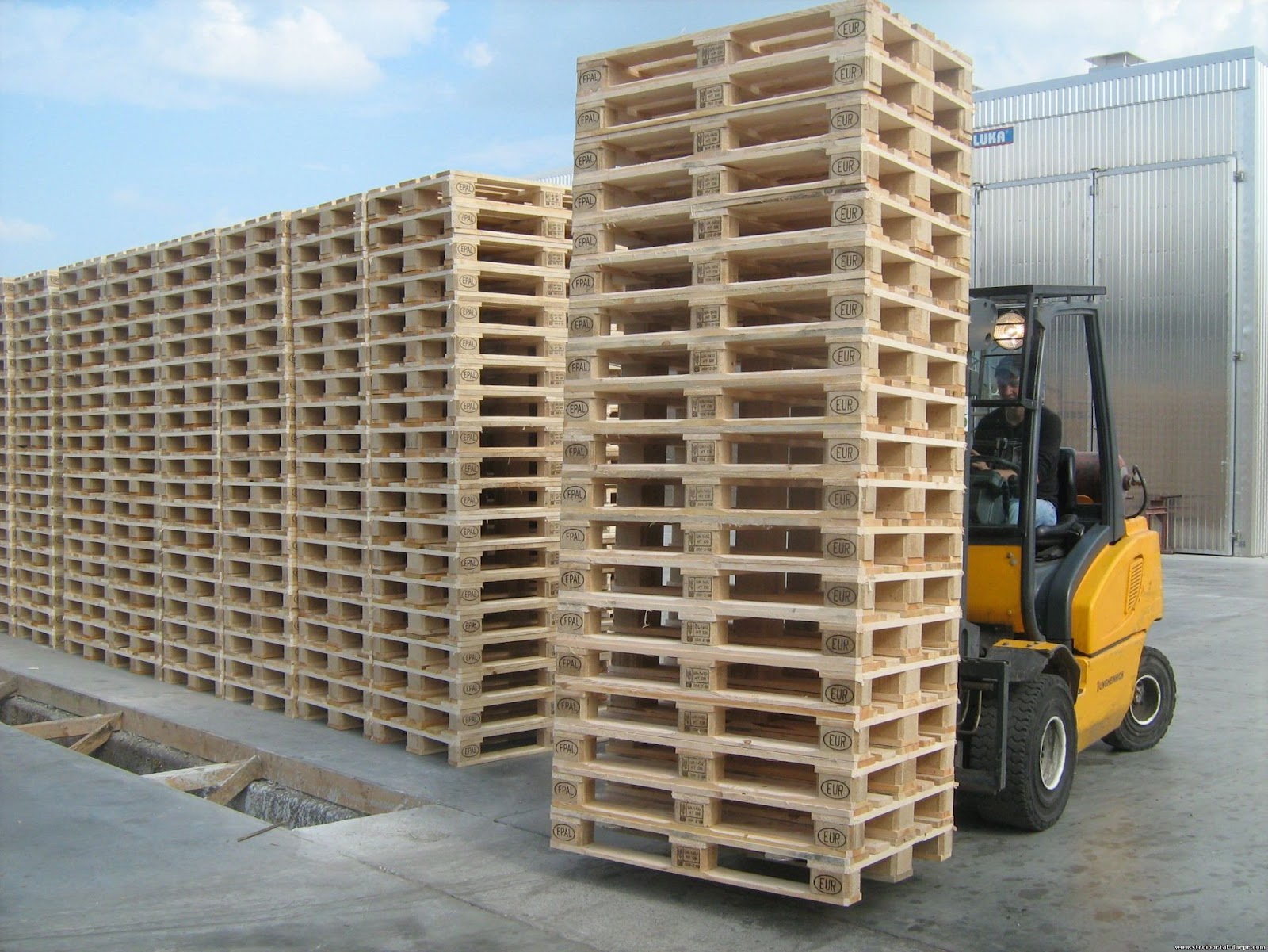
Pallets are constructed from various materials, with wood being the most prevalent. Wooden pallets are environmentally friendly, easily repaired, and relatively inexpensive. However, plastic pallets are increasingly common due to their lighter weight, resistance to rotting, and ease of storage. Metal pallets offer exceptional durability but are limited by their weight. Combined pallets incorporate advantages from all these materials.
Pallets are further classified by the number of surfaces for cargo placement, being either single-coated or double-coated. Single-coated pallets support cargo on one side only. Double-coated pallets feature two tiers, allowing for increased product placement per pallet.
Cargo is secured to any pallet type by laying (using the cargo's own weight for stability), fastening with tapes made of fabric, polymers, or metal, or wrapping with stretch or shrink film.
Why standard pallets are important?
Standard-sized pallets play a critical role in improving transportation efficiency and adaptability. For instance, they allow different components within the supply chain, and material handling equipment, to be optimized to handle specific standard sizes. The use of trucks, warehousing and even retail distribution, as well as operation with forklifts and other handling equipment can be better optimized because of standard measurements. Flexibility comes into play with respect to the ease of engaging alternative supply chain partners, where all involved parties utilize a standard pallet.
Concerning pallet conveyance, the utilization of standard pallets, such as GMA or EPAL pallets, enables businesses to scale trading operations and compete effectively, resulting in competitive pricing for pallet buyers. Since standard pallets are typically in high demand, pallet processors are motivated to collect and repair them for resale. Standard pallet usage facilitates recovery and reuse.
Conversely, when accepted pallet sizes are institutionalized and supply chains are optimized to handle them, resistance to innovations that deviate from standards may arise.
Automate stuffing with a load calculator
To simplify the load optimization process, using the ShipnGro load calculator is convenient. It works effectively with any pallet size, both standard and custom, since users can specify dimensions as needed.
We encourage you to join our for discussions on international transport activities, as well as our for shipping innovations and industry updates. Join us now!